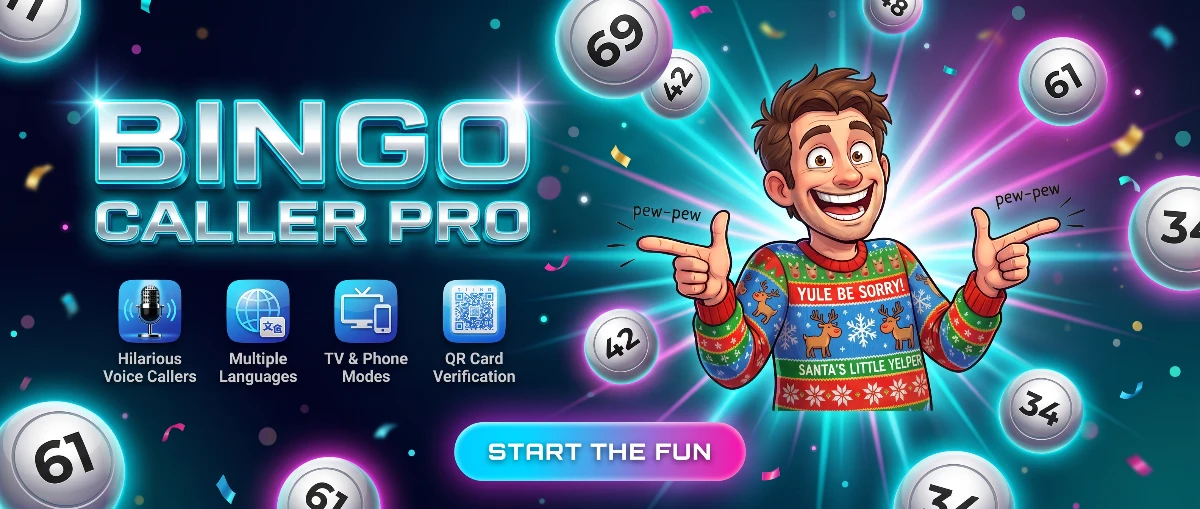
How to Host the Ultimate Bingo Night: The Complete Encyclopedia
Chapter 1: The Evolution of a Global Phenomenon
There is a vast difference between a chaotic, frustrating game night and a professionally hosted event. We have all been there: trying to run a game of Bingo, Tambola, or Housie using a rusty metal cage, losing numbered balls under the sofa, or struggling with free websites that are loaded with pop-up ads and laggy connections.
To truly host the ultimate game night, you must first understand the game. Bingo is a global cultural phenomenon dating back to 1530 in Italy. It migrated to France, and eventually reached North America in the 1920s as a carnival game called "Beano"—famously renamed "Bingo" when an excited player yelled the wrong word.
Meanwhile, the game evolved differently across the British Empire, transforming into what the UK, India, and Australia know today as Tambola or Housie. Whether you are organizing a massive charity fundraiser or an intimate living room party, this guide is your definitive masterclass on rules, math strategies, caller lingo, and the modern software required to turn your TV into a spectacular live game show.
Chapter 2: Understanding the Variants (75-Ball vs. 90-Ball)
Before you invite guests and print cards, you must decide which variant of the game you are playing. You cannot mix 75-ball cards with a 90-ball caller machine.
The 75-Ball Game (The North American Standard)
- The Card Layout: A 5x5 square grid containing 24 numbers and one "FREE" space in the center.
- Number Distribution: Grouped strictly by letters (B: 1-15, I: 16-30, N: 31-45, G: 46-60, O: 61-75).
- Winning Patterns: Players win by creating geometric shapes (horizontal line, Four Corners, Postage Stamp, or a full Blackout).
The 90-Ball Game (Tambola / Housie / European Bingo)
A longer, more suspenseful game that builds up to a grand finale.
- The Ticket Layout: A rectangular ticket featuring 3 horizontal rows and 9 vertical columns. Each row contains exactly 5 numbers.
- Winning Conditions: Played in three distinct stages: Any 1 Line, Any 2 Lines, and Full House (all 15 numbers covered).
Chapter 3: The Mathematics and Strategy of Bingo
Is Bingo a game of pure luck? Mostly, yes. However, mathematicians and stock market analysts have spent decades trying to optimize the odds of selecting a winning card before the game even begins.
The Granville Theory (Uniform Distribution)
Joseph E. Granville, a stock market analyst, believed the randomness of a Bingo machine leads to a predictable, uniform distribution. He theorized the "perfect" card should reflect this balance. Look for a card with:
- An equal balance of High numbers and Low numbers.
- An equal balance of Odd numbers and Even numbers.
- An equal distribution of ending digits (e.g., don't pick a card with five numbers ending in "4").
The Tippett Theory (Median Clustering)
L.H.C. Tippett, a British statistician, looked at the length of the game to determine strategy. In 75-ball, the exact median number is 38.
- Short Games: Balls drawn are less likely to average out and will fall closer to the extremes (1-15 and 60-75).
- Long Games (Blackout): As more balls are drawn, the average gravitates toward the median of 38. Choose a card clustered around the middle (20 through 50).
Chapter 4: The Ultimate Dictionary of Bingo Calls (1-90)
To be an ultimate host, you shouldn't just call "Number 8." You call "Garden Gate, Number 8!" Here is the traditional "Bingo Lingo" developed in crowded mid-century London bingo halls.
| Number | Traditional Call | Meaning / Origin |
|---|---|---|
| 1 | Kelly's Eye | Military slang, or a reference to Ned Kelly. |
| 2 | One Little Duck | The number 2 resembles the shape of a duck. |
| 8 | Garden Gate | Cockney rhyming slang. |
| 11 | Legs Eleven | The two 1s resemble a pair of long legs. |
| 22 | Two Little Ducks | Two 2s next to each other. |
| 44 | Droopy Drawers | A visual gag; the 4s look like sagging pants. |
| 76 | Trombones | Reference to the song "76 Trombones". |
| 88 | Two Fat Ladies | Visual gag; the 8s resemble two large, curvy figures. |
| 90 | Top of the Shop | The absolute highest number in the game. |
*(Abridged for reading flow: Master all 90 calls to host like a pro!)*
Chapter 5: Hosting Like a Casino (The Pro Workflow)
You could buy expensive paper pads and a plastic cage, but the best hosts run their games entirely digitally. If you want to eliminate stress and provide an unforgettable Game Show experience on your big screen, you need professional software.
The Ultimate "TV Mode" Experience
Most apps clutter the screen with buttons. Bingo Caller Pro features an intelligent Projector/TV Mode that splits the interface.
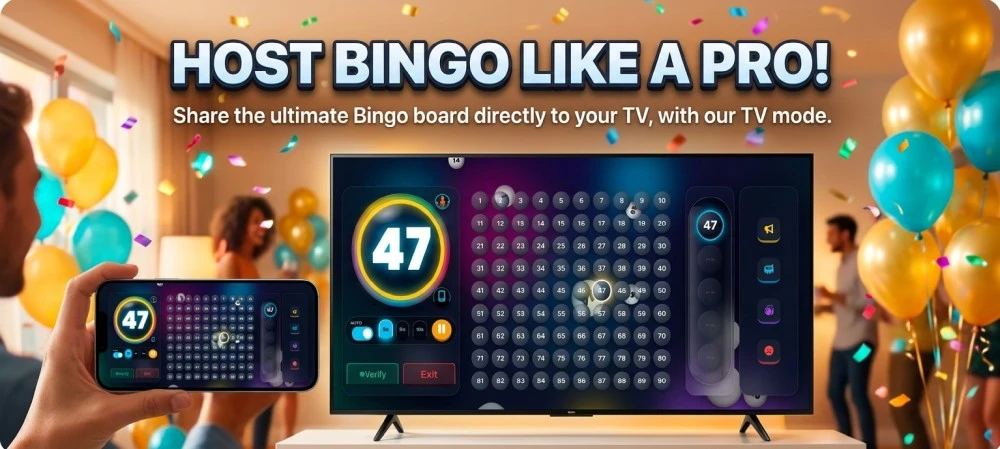
- Your Phone: Becomes the master remote control.
- The TV: Displays a stunning, high-definition Bingo Board with 3D ball drop animations!
Fully Automated Personas
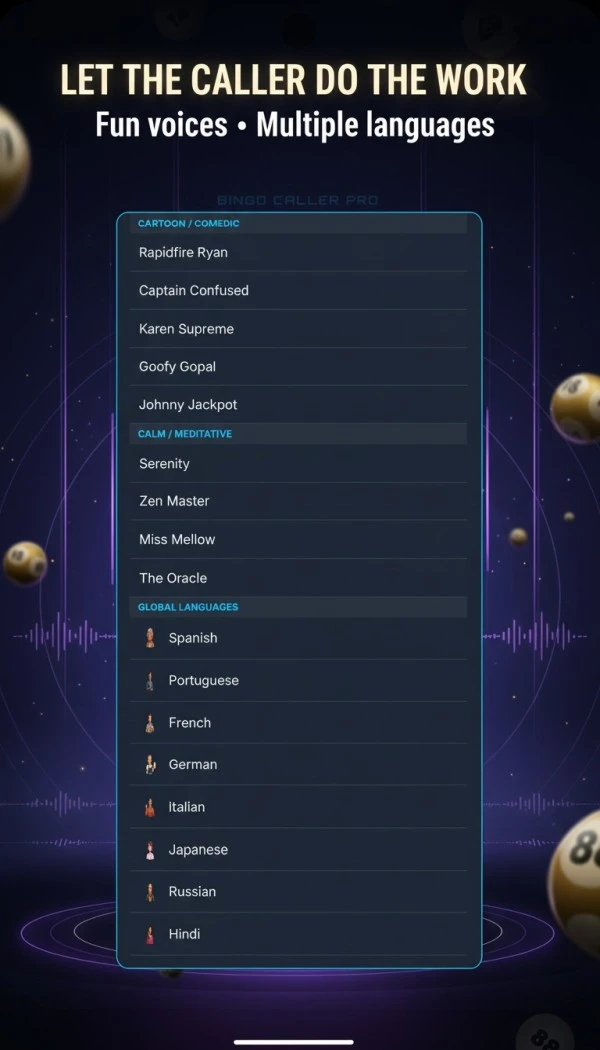
Set the Auto-Call speed to 3s, 5s, or 10s and let the app act as your MC. Switch between 9 languages and comedic personas like "Rapidfire Ryan" or "Captain Confused."
Get 9+ Voice Callers →Digital Cards & Pre-Game Lobby
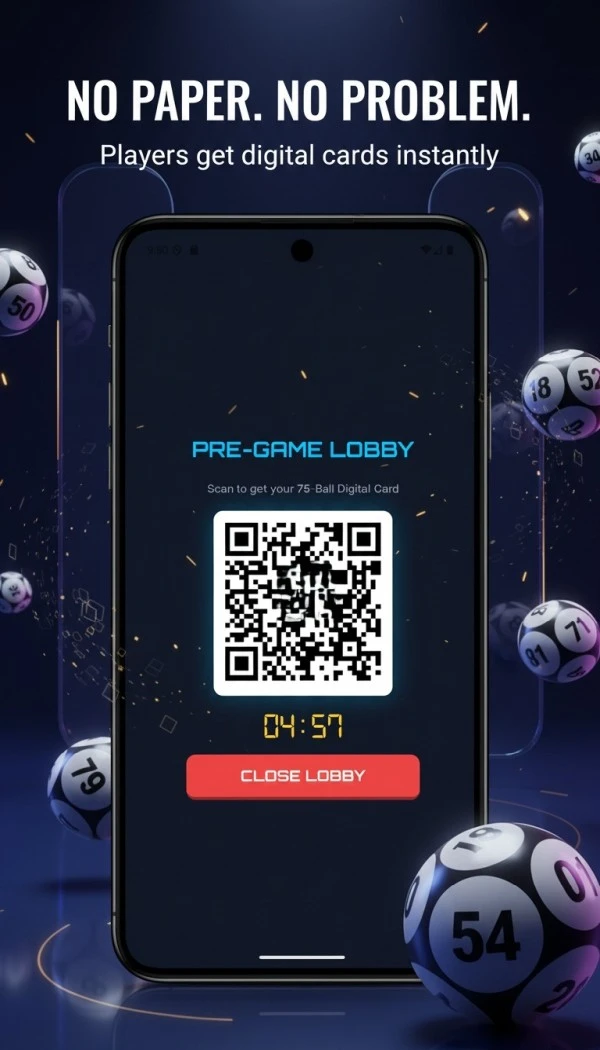
Display a QR Code on your TV with a 5-minute countdown. Guests scan it with their phones to receive interactive digital Bingo Cards instantly. No paper required!
Go Paperless Tonight →Chapter 6: Instant Anti-Cheat Verification
When someone yells "BINGO!", checking their ticket manually is stressful. Bingo Caller Pro solves this using an advanced `mulberry32` seed algorithm.
Simply ask the player for their 5-character Card ID and type it into the app's Hex Keypad. The app instantly reconstructs their exact card on the TV screen, highlights the matches, and triggers confetti if they won. You can catch a false Bingo in under two seconds! Reward winners with the built-in Hype Deck Soundboard (Applause, Airhorns) or playfully shame false calls.
Chapter 7: Fun Variations to Spice Things Up
- Speed Bingo: Set the "Auto Call" interval to 3 seconds. The panic is hilarious.
- Death Bingo: The last person to get a Bingo wins. Everyone else is eliminated as they complete patterns!
- U-Pick 'Em: Give players a blank grid to write in their own lucky numbers from 1-75 before the game starts.
Frequently Asked Questions (FAQ)
Do I need internet to host a game?
As the host, the core Bingo Caller Pro app runs offline. You do not need Wi-Fi to cast the board to your TV, auto-call numbers, use the soundboard, or verify winners via the Hex Keypad.
However, if using Digital Cards: Your players will need a basic internet connection (Wi-Fi or cellular) to scan the QR code and load their interactive cards in their web browser. If your venue has absolutely zero internet, you can easily fall back to traditional printed paper cards while still using the app entirely offline to run the show!
Does the app have a monthly subscription?
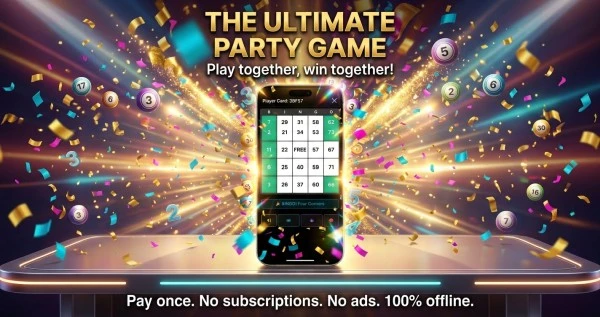
Absolutely not. Bingo Caller Pro is a premium, pay-once, keep-forever app. No subscriptions, no hidden fees, and zero advertisements.
What is a "False Bingo"?
When a player yells "Bingo!" but accidentally daubed a number that was never called. Bingo Caller Pro's Card ID verification catches this instantly.
The Final Verdict
Whether you are hosting a quick family game or a massive charity event, your tools dictate the experience. If you want to eliminate administrative stress, automate complex math, and provide a visually stunning Game Show experience on your TV, Bingo Caller Pro is the ultimate party upgrade.